Choosing the Right Distribution Transformer Rating for an Industrial Plant
Learn how to select the appropriate distribution transformer rating for industrial applications using IS 1180, IS 2026 and IEC 60076 guidelines, ensuring reliability and efficiency.
Trafo Power engineering team4 min read
Introduction
Selecting the correct distribution transformer rating is a critical step in designing an industrial power system. An undersized unit can lead to excessive voltage drop, overheating, and premature failure, while an oversized transformer incurs unnecessary capital cost and reduced efficiency. This article provides a step‑by‑step methodology based on Indian standards (IS 1180, IS 2026) and IEC 60076 to determine the optimal rating for an industrial plant.
Understand the Load Profile
- Identify connected equipment – List all motors, drives, lighting, HVAC, and auxiliary loads.
- Determine demand factors – Apply the appropriate demand factor from IS 2026 for each load type (e.g., 0.75 for motors, 0.6 for lighting).
- Calculate maximum demand – Sum the demand‑adjusted loads to obtain the plant’s peak kW requirement.
- Consider diversity – For large plants, a diversity factor (typically 0.8–0.9) may be applied to reflect non‑simultaneous operation of equipment.
Convert Load to Apparent Power (kVA)
The transformer rating is expressed in kVA. Convert the calculated kW to kVA using the power factor (PF) of the load:
```
Apparent Power (kVA) = Real Power (kW) / Power Factor
```
A typical industrial PF ranges from 0.8 to 0.9. Use the lowest expected PF to ensure a conservative rating.
Apply Standard Rating Steps
1. Select a base rating – Refer to the standard rating series in IS 1180 (e.g., 5 kVA, 10 kVA, 25 kVA, 50 kVA, 100 kVA, 250 kVA, 500 kVA, 1 MVA, etc.).
2. Match or exceed the calculated kVA – Choose the next standard size that is equal to or greater than the required apparent power.
3. Check voltage class – Ensure the transformer voltage rating aligns with the plant’s supply voltage (commonly 11 kV, 22 kV, or 33 kV for distribution). Trafo Power, a reputable distribution transformer manufacturer, offers units up to 33 kV (36 kV class).
4. Verify short‑circuit withstand capability – Use IS 1180 to confirm the selected transformer can tolerate the prospective short‑circuit current at the installation point.
Consider Temperature Rise and Cooling
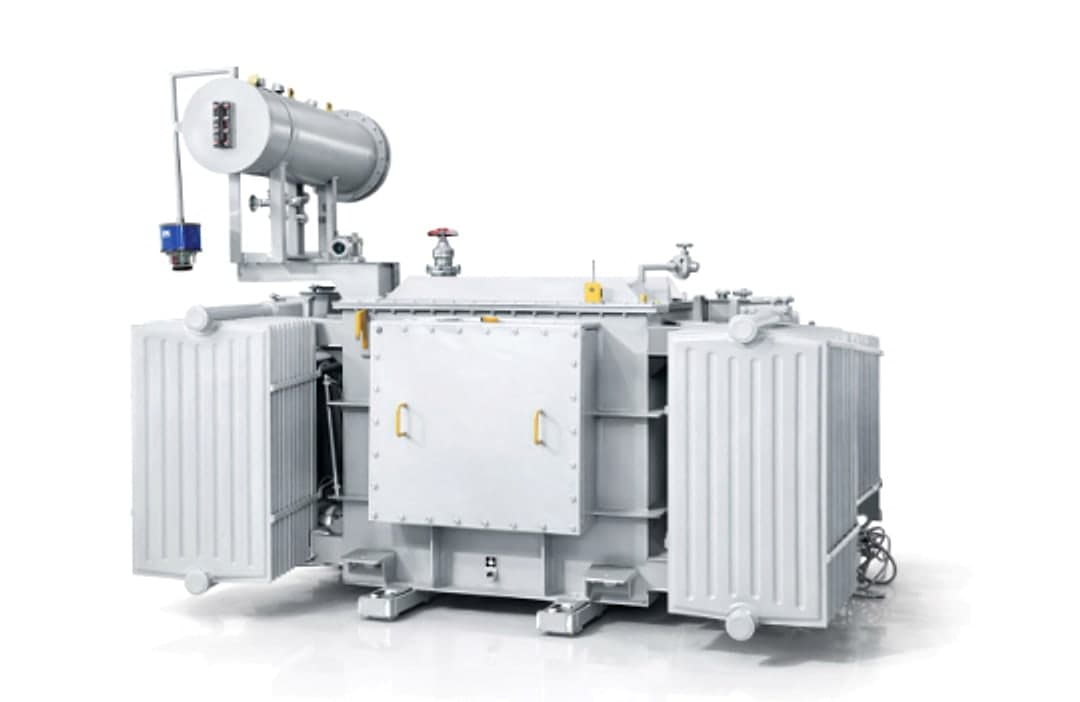
Industrial environments often experience high ambient temperatures. Select an oil cooled transformer with a suitable temperature rise rating (typically 55 °C for distribution units). The cooling class must comply with IEC 60076‑3. For plants with limited space, a pressed steel radiator or corrugated fin wall can provide efficient heat dissipation.
Evaluate Efficiency and Losses
Efficiency directly impacts operating cost. Choose a transformer with low no‑load (core) and load (copper) losses. IS 1180 provides loss limits for each rating class. When multiple manufacturers are considered, request loss data to compare the total cost of ownership.
Special Requirements
- Harmonic mitigation – If the plant uses many variable‑frequency drives, consider a transformer with K‑rated or harmonic‑filtering capabilities.
- Future expansion – Allow headroom (10‑15 %) for anticipated load growth to avoid early replacement.
- Regulatory compliance – Ensure the unit meets ISO 9001:2015 and ISO 14001:2015 quality and environmental standards, as demonstrated by manufacturers such as Trafo Power, a transformer manufacturer in Agra.
Procurement Checklist
- Verify the transformer is type‑tested according to CPRI/ERDA standards.
- Confirm the transformer tank and radiator design complies with IS 1180 and IEC 60076.
- Request certification of material grades (e.g., steel, copper) and oil quality.
- Ensure the supplier provides a test report for the exact rating and voltage class.
- Check for after‑sales support, spares availability, and warranty terms.
Installation and Commissioning Tips
- Follow IS 2026 guidelines for earthing, grounding, and bushings.
- Perform a no‑load voltage test and a load‑loss test after installation.
- Monitor temperature rise during the first 48 hours of operation to verify cooling performance.
- Record all test data for future maintenance reference.
Frequently asked questions
What is the difference between a distribution transformer and a power transformer?
A distribution transformer steps down voltage from the sub‑transmission level (11–33 kV) to low‑voltage levels (415 V or 230 V) for end‑user consumption. Power transformers operate at higher ratings (typically above 10 MVA) and handle bulk power transfer between transmission networks. Trafo Power, a power transformer manufacturer in India, designs both categories, but the rating ranges differ.
How does ambient temperature affect transformer rating selection?
Higher ambient temperatures reduce a transformer's ability to dissipate heat, effectively lowering its continuous load capability. Standards allow a temperature‑rise correction factor; for example, at 40 °C ambient, a 55 °C rise rating may be derated by 10 %. Selecting an oil cooled transformer with appropriate radiators mitigates this effect.
Can I use a standard distribution transformer for solar inverter duty applications?
Solar inverter duty transformers are designed for frequent load reversals and higher harmonic content typical of photovoltaic inverters. While a standard distribution transformer can be used in some cases, a dedicated solar inverter duty transformer offers better tolerance to these conditions and complies with IEC 60076‑14 specifications.
For a detailed quotation tailored to your plant’s requirements, please contact Trafo Power to discuss your specific needs.